English| EUR
Suggested for you
More currencies
Choose a language
Kirkenes sits at the edge of two crab fisheries. The Barents Sea king crab safari industry centers on the red king crab, an introduced Pacific species now thriving in Norwegian fjords, while snow crabs inhabit deeper offshore zones and appear less frequently in visitor experiences. Understanding which species you'll encounter shapes expectations for size, flavor, and the mechanics of handling live specimens during guided tours.
Quick answer
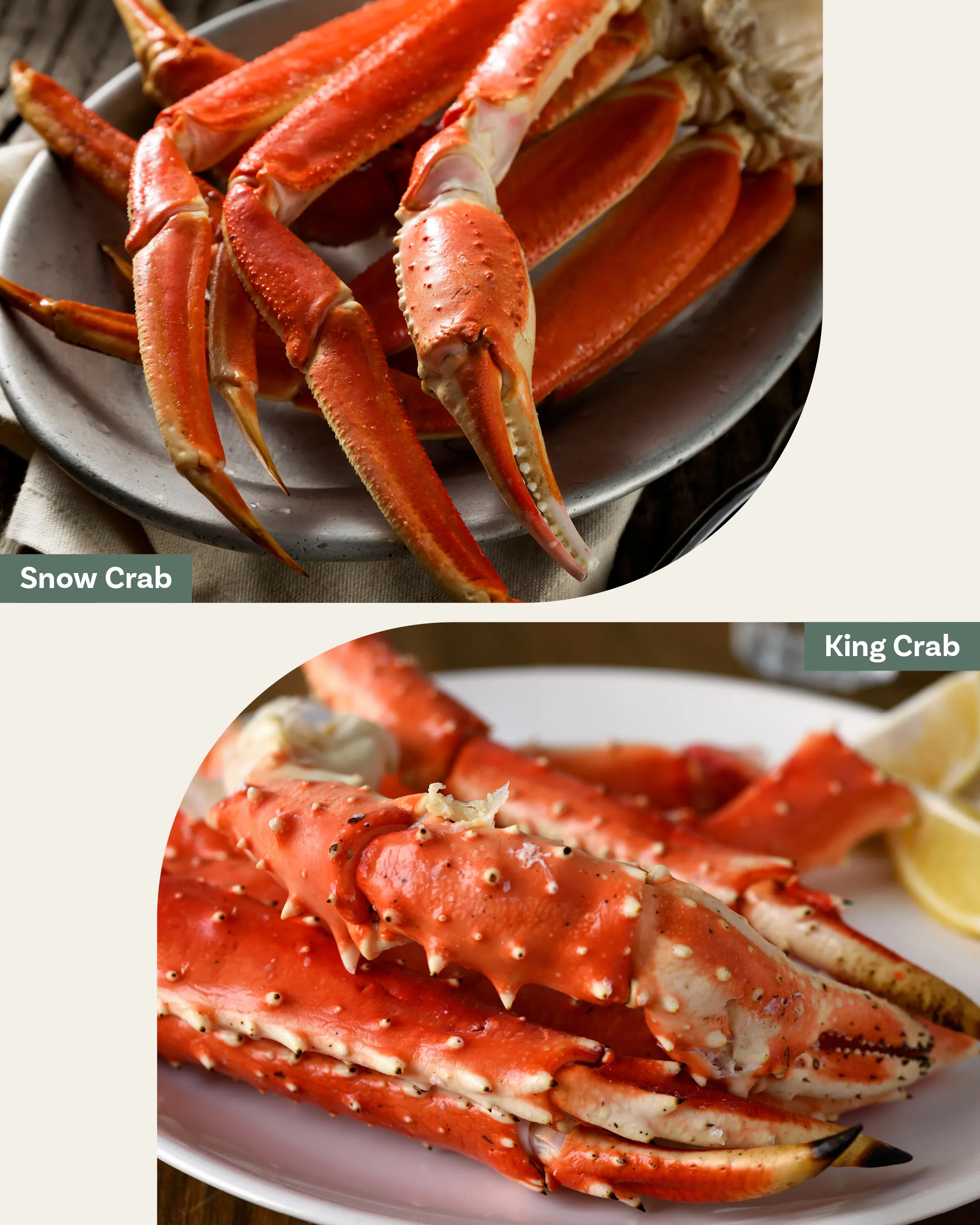
King crabs and snow crabs are distinct species separated by leg span, body structure, and habitat. Red king crabs in Kirkenes waters measure up to 1.8 meters across, carry eight walking legs plus two feeding claws, and inhabit shallow coastal zones year-round. Snow crabs reach 90 centimeters, possess ten legs, and occupy deeper Barents Sea beds beyond the reach of most shore-based safaris. The king crab snow crab difference matters most in tour selection: nearly all Kirkenes crab experiences target the larger, more accessible red king crab.
A single red king crab can span the width of a dining table. That leg reach—routinely exceeding 150 centimeters from claw to claw—makes the species unmistakable in Kirkenes fjords, where guided safaris pull traps from 15 to 40 meters of water. Snow crabs, by contrast, cluster on muddy slopes 200 to 1,400 meters down, far beyond the operational range of the rigid inflatable boats and nearshore traps that define the visitor crab-safari model. The king crab snow crab difference begins with taxonomy. Red king crabs (Paralithodes camtschaticus) belong to the lithodid family and carry eight true walking legs; what appears to be a missing pair folds beneath the carapace, invisible until the animal is turned over. Snow crabs (Chionoecetes opilio) are true crabs with ten legs and a flatter, circular shell. In Kirkenes waters, red king crabs dominate the safari trade because they inhabit the accessible intertidal and subtidal zones where operators have refined trap placement and retrieval over two decades. The species was deliberately introduced to the Murmansk coast in the 1960s, migrated west into Norwegian waters by the 1990s, and now supports both a commercial fleet and a tourism economy built around live handling and dockside preparation. Flavor and texture separate the two species in culinary terms. King crab leg meat is sweet, firm, and dense, with individual segments yielding 80 to 120 grams of white muscle per leg. Snow crab meat is more delicate, with a briny mineral note and thinner strands that require gentler steaming. Most Kirkenes safari operators prepare king crab on-site using seawater boil or outdoor propane burners, a demonstration that doubles as the meal itself. Snow crab rarely appears in these settings; its commercial harvest supplies export markets rather than the dockside tourism chain. Understanding which species populates Kirkenes safari itineraries removes confusion at booking. If the tour departs from a coastal base, operates in daylight, and includes trap hauling within sight of shore, the target is red king crab. Snow crab expeditions require offshore vessels, winches rated for deep water, and longer transit times—infrastructure absent from the Snowhotel and harbor-based operators that anchor the regional crab tourism sector. The king crab snow crab difference is not a matter of quality but of access, and in Kirkenes the red king crab's shallow-water adaptation has made it the practical and iconic choice for visitor encounters.
“A single red king crab can span the width of a dining table.”
The period from January to April offers the most stable conditions for Barents Sea crab safaris, as ice coverage facilitates traditional winter fishing methods. During these months, both king crab and snow crab are highly active in the cold, nutrient-rich waters near Kirkenes.
Cold, -15°C to -5°C. Stable ice conditions provide consistent access for crab harvesting activities.
Mild, 5°C to 15°C. Longer daylight hours allow for boat-based safari options and viewing of the midnight sun.
Variable, -5°C to 5°C. Autumn brings dark skies and potential northern lights, though sea conditions can be more unpredictable for offshore access.
Verdict: For the most reliable access to both crab species, visit between January and April when winter conditions are most consistent.
The Snowhotel grounds, where king crab and snow crab excursions are coordinated, remain open to visitors throughout the week.
Access to the Snowhotel grounds is available at no cost. Participation in hands-on king crab and snow crab tours requires booking a paid excursion.
Verdict: There is no entrance fee for the premises, while the final cost for crab experiences depends on the specific tour package selected.
The base for king crab and snow crab experiences is located at Sandnesdalen 14, 9910 Bjørnevatn, just outside Kirkenes. Most visitors reach the site by car or pre-arranged transfer from Kirkenes town center or the airport.
Drive via E6 toward Bjørnevatn, then follow signs to Sandnesdalen
Available from Kirkenes Airport (KKN) or Kirkenes town
Public bus lines connect Kirkenes to Bjørnevatn
For the best visibility and access to outdoor activities, plan your arrival between 09:00 and 17:00. On-site parking is available for those arriving by private vehicle.
Everything you need to know about king crab snow crab difference
The primary king crab snow crab difference lies in their size, habitat, and physical structure, with the Red King Crab often being significantly larger. While the king crab is prized for its massive legs, the snow crab has a distinct, sweeter flavor profile that many seafood enthusiasts enjoy. Understanding this king crab snow crab difference helps visitors appreciate the local Barents Sea ecosystem during their excursions. Both species are iconic to the region, though they thrive in different depths and environments. When you embark on a Kirkenes crab safari, you will frequently encounter the Red King Crab, known for its heavy armor and impressive size compared to the snow crab. The king crab snow crab difference in anatomy is quite visible, as the king crab possesses a more triangular carapace and longer, thicker legs. Visitors often find that the king crab snow crab difference is best explained by our expert guides who handle these crustaceans safely during the tour. You can taste both, as local culinary traditions in Northern Norway highlight the unique textures and savory qualities of each species. Please note that while both are part of our marine heritage, the specific availability of each can fluctuate based on seasonal harvesting regulations and fishing patterns. Whether you are observing them in their natural habitat or enjoying a meal, the king crab snow crab difference is a common topic of interest among guests at our facility. Entry to our grounds is 0 NOK, and you can view our current tour offerings on our website to see how we showcase these marine giants. Remember to plan your visit between 09:00 and 17:00 for the best visibility during your outdoor experience, and feel free to explore our booking widget for scheduled tour availability.